First Dark Age
Last and First MenThe First Dark Age is the hundred-thousand-year collapse of organized human life after the fall of the First World State. Rather than a brief interruption followed by recovery, it was a prolonged civilizational eclipse: the survivors fell into savagery, and the return to civilization came only near the end of the period. Its duration and severity expose how a society’s material achievements can outlast the capacities needed to sustain them.
Chronology and Boundaries
The period begins with the downfall of the First World State, set less than five thousand years after Newton’s life. For the first hundred thousand years of the first million following the collapse, humanity remained in complete eclipse. Only at the close of that span did people struggle again from savagery through barbarism into civilization. The ensuing renaissance was brief by comparison, lasting about fifteen thousand years from its earliest beginnings to its end.
That later civilization’s final crisis damaged the planet so severely that human mentality fell into a further slumber lasting ten million years, the Second Dark Age. The distinction matters: the First Dark Age names the long deprivation immediately after the First World State, not the vastly longer eclipse that followed the later renaissance.
The World State’s Failure and Its Human Causes
The immediate material trigger was the sudden failure of coal supplies. The original coalfields had been exhausted centuries earlier, and for thousands of years Antarctica had provided the principal remaining supply. Its abundance encouraged a belief that it could not run out. When reports finally disclosed that even the deepest borings had found no further deposits, disbelief delayed recognition of the crisis.
The society had already been shaped around energy-intensive practices. After its oil supply gave out in less than three centuries, it used electricity generated from coal to power transport, while wind, water, volcanic sources, and subterranean heat supplemented but never replaced the Antarctic seams. As coal failed, curtailing ritual flight would have conserved enormous resources, but that practice was bound to religious faith and to the standing of the flying aristocracy. The ruling scientists instead presented the shortage as a test of faith and urged increased ritual devotion. The response preserved ceremony at the expense of the practical adjustment the crisis demanded.
The collapse was compounded by a widespread epidemic of insanity and a still more extensive deterioration of intelligence resulting from the use of microbes. This seizure prevented people from checking the breakdown at its earliest, more manageable stage. Even after the epidemic passed, rebuilding required a degree of collective commitment that most of the First Men could not muster. Disillusionment, fatigue, and despair followed the failure of both social order and confidence in the world; four thousand years of routine had, in the narrator’s account, left human nature unable to adapt quickly to wholly changed conditions.
A deeper physiological pressure further weakened recovery. The gradual process described as general senescence of the species destabilized individuals’ chemical equilibrium and eroded humanity’s former capacity for prolonged youth. A biologically unnatural environment and sustained high-pressure living aggravated the change. The account thus connects the immediate energy crisis to longer-term limits in human resilience rather than treating the loss of civilization as the consequence of fuel depletion alone.
Survival and Social Life
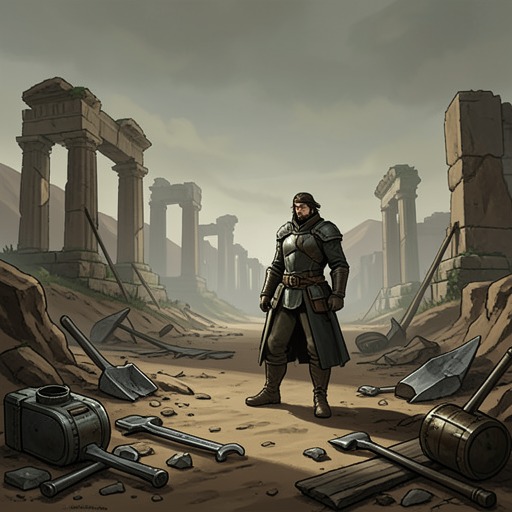
Only a tenth of the population survived the disaster. The remnant consisted largely of agriculturists, a group the old order had regarded as sluggish and socially base. With machinery, power, and chemical fertilizers gone, these survivors had to keep themselves alive through arduous cultivation. Their children inherited no functioning civilization; for the second generation, the former world was already a legend.
The family, or a tribe of families, became the largest stable social unit. Communities fought over local territory and resources, including in conflicts between valley populations and marauding bands. Small military tyrants rose and fell, but none could maintain authority over a broad region. With no surplus wealth to support government or trained armies, durable political unity was beyond reach. Women’s social position also reverted to dependent domestic status within this fragmented order.
The physical limits of the used planet intensified the hardship. Coal and oil were no longer available, and many minerals had disappeared from depths accessible to the survivors’ weak tools and limited technical capacities. Iron required mechanical mining, which they could no longer perform, so people returned to stone implements. They lacked the skill and persistence needed to reproduce the delicate flaking of Paleolithic tools or the smooth symmetry of Neolithic ones. The loss was not simply industrial: even the techniques of much earlier societies had become difficult to recover.
Historical Significance
The First Dark Age demonstrates the gap between possessing a civilization and possessing the adaptability to rebuild one. The First Men had sustained a world-spanning order, but its energy systems, religious commitments, and social habits did not equip them to respond effectively when its foundations failed. A crisis that might have been contained by conserving power instead became irreversible amid institutional resistance, mental deterioration, and dwindling resources.
The period’s slow passage from civilizational memory to legend gives its scale a human consequence: descendants of the World State did not inherit its knowledge as a usable system. They inherited the labor of survival, scattered local conflicts, and fragments of a past they could no longer reproduce. The later renaissance marks a recovery, but not a restoration of the old continuity; the First Dark Age remains the long rupture between the First World State and civilization’s next emergence.